> ## Documentation Index
> Fetch the complete documentation index at: https://support.yena.ai/llms.txt
> Use this file to discover all available pages before exploring further.
# Understanding the market read
> What the Sourcer's pool assessment tells you, and how to use it with clients.
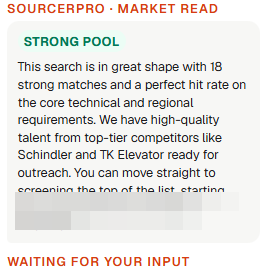
Every finished search includes a market read: a plain-language assessment of the pool the Sourcer just screened.
 ## What it contains
* **Pool strength** — how many genuinely strong matches exist against your must-haves, not how many profiles vaguely resemble the title.
* **Where the talent sits** — the employers that keep appearing across the shortlist. That's your approach map and your client's competitive context in one.
* **A recommendation** — whether you can go straight to screening, or should widen the brief first.
## How to read a thin pool
A thin pool is a finding, not a failure. It usually means one constraint is doing too much filtering — often language or radius in DACH searches. Before promising a client numbers, check which [suggestion](/en/sourcer/refining-a-search) the Sourcer proposes; loosening the right constraint is a conversation you can now have with evidence.
## Using it commercially
The market read is client-safe by design: it describes the market, not individuals. Quoting it in a status update ("18 strong matches, concentrated at three competitors") makes your work visible — and it's the backbone of the [market-read BD play](/en/guides/market-read-bd).
## What it contains
* **Pool strength** — how many genuinely strong matches exist against your must-haves, not how many profiles vaguely resemble the title.
* **Where the talent sits** — the employers that keep appearing across the shortlist. That's your approach map and your client's competitive context in one.
* **A recommendation** — whether you can go straight to screening, or should widen the brief first.
## How to read a thin pool
A thin pool is a finding, not a failure. It usually means one constraint is doing too much filtering — often language or radius in DACH searches. Before promising a client numbers, check which [suggestion](/en/sourcer/refining-a-search) the Sourcer proposes; loosening the right constraint is a conversation you can now have with evidence.
## Using it commercially
The market read is client-safe by design: it describes the market, not individuals. Quoting it in a status update ("18 strong matches, concentrated at three competitors") makes your work visible — and it's the backbone of the [market-read BD play](/en/guides/market-read-bd).